XCIENT Fuel Cell Truck warning lights: 15 signals to check before the next haul
Official 2026 Hyundai XCIENT Fuel Cell Truck warning-light guide covering 15 key signals, including brake, steering safety, power down, traction-battery, f...
The XCIENT Fuel Cell Truck is the kind of vehicle where one ignored warning light can snowball into lost route time, towing, cargo delays, and a much larger repair bill. That is why you should separate brake, steering safety, charging, coolant, power-down, traction-battery, and front-attention alerts as quickly as possible. This guide is based on the official 2026 Hyundai XCIENT Fuel Cell Truck QZFCEV warning-light page and owner's manual and narrows the dashboard down to 15 signals worth checking first. Model year and equipment can change what appears on your cluster, so compare the icon against the official page before you trust a perfect match.
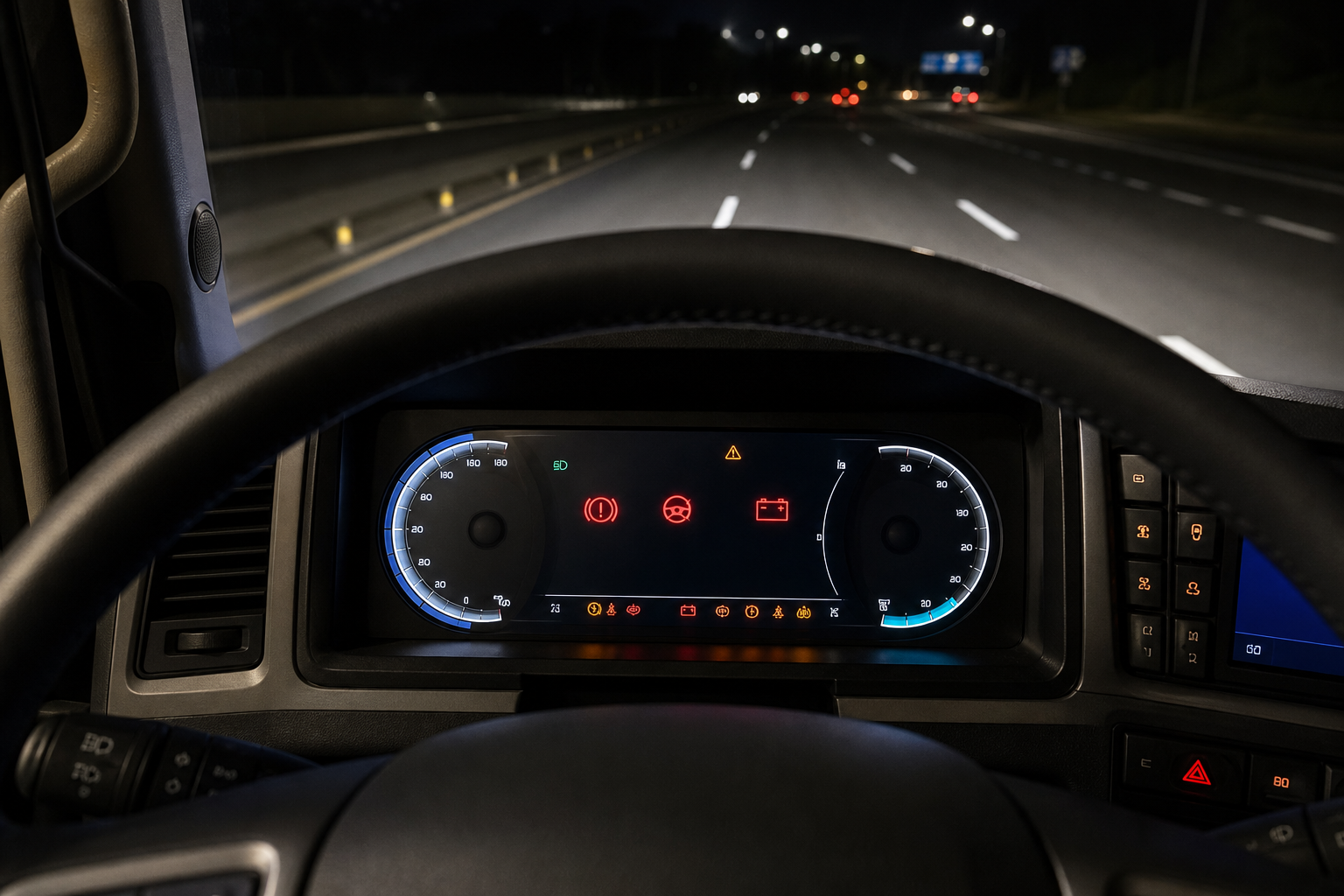
How to sort these warning lights quickly
- Red: stop-now or inspect-now alerts, especially brake, steering, charging, coolant, airbag, and front-attention warnings.
- Amber: not always a hard stop, but not something to postpone. TPMS, ABS, front-safety, power-down, and traction-battery warnings live here.
- Green or blue: many are status lights, but the cluster message can still change the meaning.
- Shared Hyundai library caution: the official list can still surface diesel or AWD icons. Match the exact symbol and your fuel-cell-truck specification before you act on it.
15 XCIENT Fuel Cell Truck warning lights worth checking first
| Type | Light | Meaning | What to do now |
|---|---|---|---|
| Immediate |  Steering safety Steering safety | A steering-related safety fault may be active | If steering feel changes, stop planning the next long leg and inspect it |
| Immediate |  Brake Brake | Parking brake, low fluid, or a braking-system issue | Slow down and check it before the route gets any longer |
| Immediate |  Charging Charging | Electrical or charging-system fault | Reduce unnecessary electrical load and arrange service soon |
| Immediate |  Coolant temperature Coolant temperature | Cooling-system temperature may be too high | Park safely and let the truck cool before pushing further |
| Immediate |  Electric power steering Electric power steering | Steering-assist malfunction | If the wheel feels heavy, do not treat it like a normal run |
| Immediate |  Airbag Airbag | Airbag or pretensioner fault | Do not ignore crash-protection warnings on a commercial truck |
| Driver focus |  Front attention Front attention | Driver-attention or related monitoring warning | If fatigue is part of the problem, stop and reset before the next haul |
| Combined |  Master warning Master warning | Another message or fault is waiting elsewhere on the cluster | Read the message before you guess what the icon means |
| Front safety |  Front safety Front safety | Front-safety feature blocked, disabled, or malfunctioning | Check camera or radar contamination first, then inspect it if it returns |
| Braking assist |  ABS ABS | Anti-lock braking fault | Treat rain, slopes, and loaded braking more cautiously |
| Tires |  Low tire pressure / TPMS Low tire pressure / TPMS | Low tire pressure or a TPMS fault | Check pressure early because heavy loads magnify the risk fast |
| Parking control |  Electronic parking brake Electronic parking brake | EPB apply or release issue | Confirm proper holding before any slope or loading task |
| Fuel-cell drivetrain |  Power down Power down | Output may be limited to protect the fuel-cell or drive system | Avoid climbs, overtakes, and heavy-route assumptions until it is understood |
| Fuel-cell drivetrain |  Traction battery state of charge Traction battery state of charge | High-voltage traction-battery state may be too low for the next plan | Recalculate the route around your next support or charging point |
| Night safety |  LED headlamp LED headlamp | Headlamp-system or component issue | Fix it before another dark or early-morning route |
These icons were checked against the official 2026 Hyundai XCIENT Fuel Cell Truck QZFCEV warning-light API. The shared Hyundai library can still show diesel or AWD items, so compare the exact symbol and message before assuming the label applies.
1. Red warnings decide whether this run should continue at all
Brake, steering-safety, charging, coolant, EPS, airbag, and front-attention alerts are not paperwork lights. On a commercial fuel-cell truck they can turn into real route risk fast because weight, braking distance, and long operating hours all amplify the consequence.
Charging and coolant warnings matter even more than they look. A fuel-cell truck still depends on healthy electrical and thermal control, so a warning here can quickly become reduced performance or a stopped trip instead of a minor inconvenience.
2. The amber lights answer “can I still run the next leg safely?”
ABS, TPMS, EPB, front safety, and the master warning light often mean the truck still moves, but the smarter question is whether it should keep working without a closer look. On wet roads, slopes, or loaded operation, those “inspect soon” warnings matter more than they do on a lighter passenger vehicle.
The master warning light is especially easy to misuse. It is only a headline, not the full story, so read the cluster message before guessing whether the problem is steering, front safety, electrical load, or something else.
3. Power down and traction-battery warnings are the fuel-cell-truck core signals
The official 2026 QZFCEV warning-light list makes it clear that power down is one of the defining signals for this truck. If output feels limited, do not translate that into “slightly weaker today.” On climbs, merges, and loaded operation it changes the safety margin quickly.
Traction-battery state-of-charge warnings belong in the same decision group. The route plan, support point, and remaining operating margin all need to be reconsidered before you keep driving as if the truck were in a normal state.
The shared Hyundai warning library can also show diesel items such as water-in-fuel or urea warnings on the same official screen. For a fuel-cell truck, do not assume those apply unless the exact icon and cluster message actually appear on your own vehicle.
4. Treat the fuel-cell and hydrogen side as service-level territory
This truck mixes a fuel-cell system, high-voltage hardware, and commercial-duty electrical loads. If output reduction, traction-battery alerts, steering warnings, or hydrogen-related service messages start stacking together, that is not the moment to improvise with a roadside guess.
If the cluster points toward the hydrogen or fuel-cell side, the safer move is to follow the official manual and commercial-service path instead of trying to touch or inspect those systems directly.
5. Change the model year before you trust the match
This article follows the 2026 Hyundai XCIENT Fuel Cell Truck QZFCEV. Even with the same model name, 2025, 2026, and 2027 model years can use different warning-light combinations and explanations. Open the official page, switch to your exact year, and then compare the symbol again.
Related guides
In short, XCIENT Fuel Cell Truck warning lights make more sense when you separate stop-now red alerts, inspect-soon amber alerts, and fuel-cell-specific output or traction-battery signals. When the icon feels ambiguous, compare it directly against the official page instead of guessing.