INSTER warning lights: 16 dashboard signals to check first
Official 2026 Hyundai INSTER warning-light guide covering 16 dashboard signals, from brake and 12V charging alerts to EPS, master warning, power down, READ...
The Hyundai INSTER feels simple and quiet right up until a warning light appears. On this EV, the signals that matter first are usually brake, 12V charging, EPS, master warning, power down, READY, and high-voltage battery level. This guide is based on the official 2026 Hyundai INSTER warning-light page and narrows the list to the 16 dashboard signals most worth checking first. Model year, battery condition, and equipment can change what you see, so compare your own year on the official page before you trust a perfect match.
Compare the icon before you guess
The official AXEV library can still surface shared Hyundai symbols for fuel, GPF, diesel, and AWD systems. Judge urgency first, then match your exact icon on the official page.
Check my INSTER icon on the official warning-light page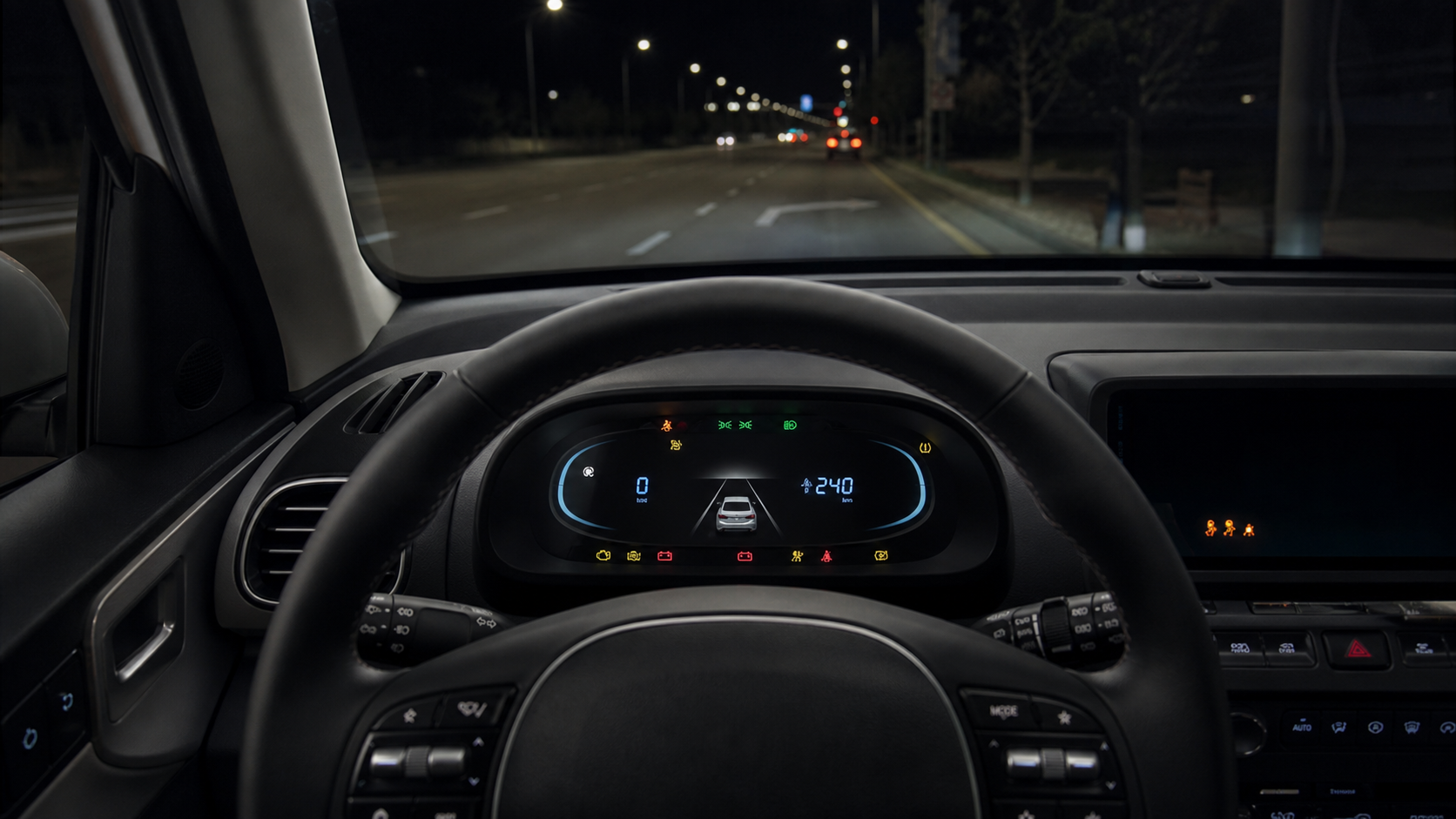
How to judge INSTER warning lights quickly
- Red: stop or inspect immediately. Brake, charging, EPS, airbag, and forward-attention warnings belong here.
- Amber: you may still be able to drive, but you should find the cause soon. ABS, TPMS, EPB, ESC, LED headlamp, front-safety, master warning, and EV battery warnings fit here.
- Green or blue: many are status indicators, but READY matters because it confirms the car is truly drive-ready.
- EV-specific: power down, high-voltage battery level, and battery conditioning affect output, charging plans, and battery temperature management.
16 INSTER warning lights worth checking first
| Type | Light | Meaning | What to do now |
|---|---|---|---|
| Immediate |  Brake Brake | Parking brake applied, low brake fluid, or a braking fault | Slow down safely and inspect it if the light stays on |
| Immediate |  Charging Charging | 12V support battery or charging-system issue | Reduce electrical load and plan a prompt inspection |
| Immediate |  Electronic power steering Electronic power steering | Steering-assist malfunction | If the wheel feels heavy, stop demanding driving and inspect it |
| Immediate |  Airbag Airbag | Airbag-system fault | Do not leave it unresolved because crash protection may be reduced |
| Immediate |  Forward attention Forward attention | Driver-monitoring or urgent attention warning | Check the message, your alertness, and the related sensors together |
| Combined |  Master warning Master warning | Another message or fault is waiting elsewhere on the cluster | Read the message panel before assuming it is minor |
| Braking assist |  ABS ABS | Anti-lock braking fault | Pay extra attention if it appears with the red brake light |
| Tires |  Low tire pressure Low tire pressure | Low pressure or TPMS issue | Check all four tires before the next faster drive |
| Parking |  Electronic parking brake Electronic parking brake | EPB-system issue | Check apply and release behavior, then schedule service if it stays on |
| Stability |  ESC ESC | Stability-control intervention or fault | Flashing can mean active control; a steady light means inspect it |
| Front safety |  Front safety Front safety | Front-safety system disabled, blocked, or malfunctioning | Clean the sensors first and inspect it if the alert returns |
| Night safety |  LED headlamp LED headlamp | Headlamp-system issue | Check lighting before night or rain driving |
| EV core |  Power down Power down | Output is being limited to protect high-power EV components | Avoid hard acceleration and check battery level and thermal condition |
| EV core |  High-voltage battery level High-voltage battery level | Drive battery charge is running low | Change the plan and head for a nearer charger first |
| Status |  READY READY | Confirms the car is actually ready to move | Check READY before selecting drive and moving off |
| Battery care |  Battery conditioning Battery conditioning | Battery temperature-management mode is active | Use it as a clue when charging speed or power delivery feels different |
Icons were checked against the official 2026 Hyundai AXEV warning-light API. The shared Hyundai library can still surface non-EV symbols, so compare your exact icon before assuming a title applies.
1. Red lights deserve faster attention in a quiet EV
Because the INSTER is so quiet, you cannot rely on sound and vibration to tell you how serious a problem feels. Brake, charging, EPS, airbag, and forward-attention warnings need quicker judgment because the car may still feel calm while the dashboard is already telling you to stop and check.
2. Master warning, TPMS, and front-safety alerts change daily driving confidence
Amber warnings are not always emergencies, but they can change how comfortable the next drive feels. Master warning tells you another message is waiting, TPMS can matter much more at higher speed than it feels in town, and front-safety alerts may simply reflect blocked sensors or a function that is no longer fully available.
3. Treat power down, battery level, and READY as the EV trio
Power down means output is being limited to protect the EV system. High-voltage battery level is your route-planning warning, while READY confirms whether the car is truly prepared to move. Add battery conditioning to that group when charging speed or battery temperature seems to be part of the story.
4. Switch the model year before trusting a perfect match
This article is organized around the 2026 Hyundai INSTER AXEV. Even with the same model name, 2025, 2026, and 2027 model years can use different warning-light combinations and explanations. Open the official page, switch to your own year, and then compare the icon again.
Related EV warning-light guides
In short, INSTER warning lights are easier to handle when you split them into stop-now red alerts, inspect-soon amber alerts, and EV-specific output or charging signals. When the symbol feels ambiguous, compare it directly against the official warning-light page instead of relying on a guess.