Hyundai Porter II Electric warning lights: 17 EV truck dashboard signals to check first
Official 2026 Hyundai Porter II Electric warning-light guide covering 17 EV truck dashboard signals, from brake, charging, and TPMS alerts to power-down, R...
The Porter II Electric is quiet enough that a warning light can feel less urgent than it really is. That is exactly why EV truck drivers should separate brake, steering, and charging faults from power-down, READY, battery-conditioning, and high-voltage battery alerts as quickly as possible. This guide is based on the official 2026 Hyundai Porter II Electric HREV warning-light page and owner's manual and narrows the list to 17 dashboard signals worth checking first. Model year, battery condition, equipment, and payload can change what appears on your own truck, so switch to your exact year on the official page before trusting a perfect match.
Match the icon before you guess
The shared Hyundai library can still surface diesel, GPF, or AWD symbols next to Porter II Electric warnings. Judge urgency first, then compare the exact icon on the official warning-light page.
Check my Porter II Electric icon on the official warning-light page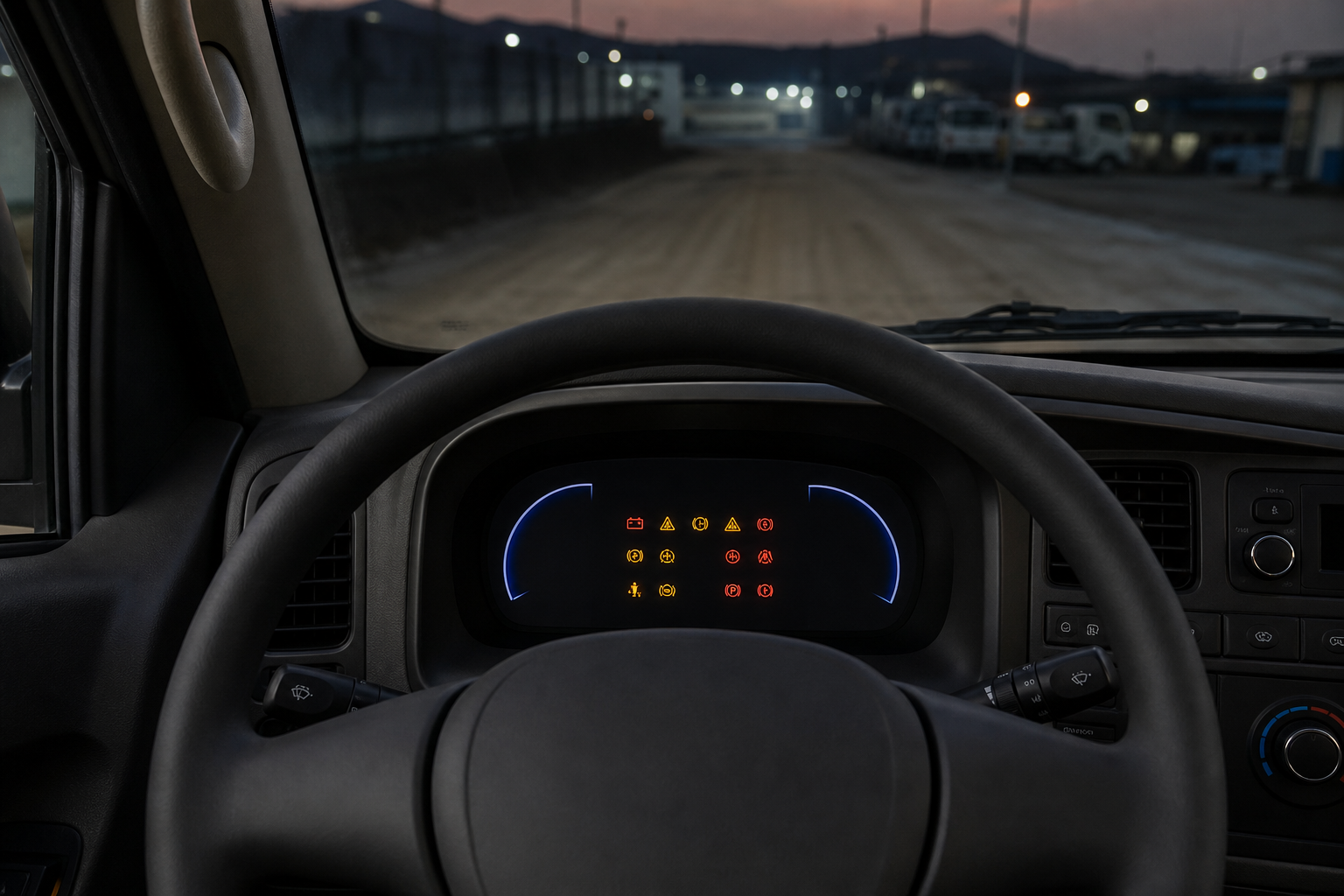
How to sort Porter II Electric warnings quickly
- Red: brake, charging, coolant-temperature, EPS, steering-safety, and airbag warnings deserve immediate attention.
- Amber: engine, ABS, TPMS, EPB, ESC, master warning, and front-safety lights may still allow driving, but they should not wait long.
- Green: on this EV truck, READY matters because it tells you whether the truck is actually prepared to move.
- EV-specific: power-down, high-voltage battery, and battery conditioning can change both output and charging plans.
17 Porter II Electric warning lights worth checking first
| Type | Light | Meaning | What to do now |
|---|---|---|---|
| Immediate |  Brake Brake | Parking brake, low brake fluid, or braking-system fault | Slow down safely and inspect it if the light stays on |
| Immediate |  Charging Charging | 12V charging-system or charging-device issue | Reduce electrical load and inspect it promptly |
| Immediate |  Coolant temperature Coolant temperature | Cooling-system temperature may be outside the safe range | Stop pushing the truck and arrange inspection |
| Immediate |  Electronic power steering Electronic power steering | Steering-assist malfunction | If the wheel feels heavy, inspect it before the next stop-start run |
| Immediate |  Steering safety Steering safety | Emergency steering or side/front safety function issue | Clear sensor blockage first, then inspect it if the alert remains |
| Immediate |  Airbag Airbag | Airbag or pretensioner fault | Do not leave it unresolved because crash protection may be reduced |
| Inspect soon |  Engine Engine | Treat it as a shared control-system fault on this EV truck | If it lasts beyond startup or returns while driving, inspect it soon |
| Braking assist |  ABS ABS | Anti-lock braking fault | Take it more seriously in rain or under load |
| Tires |  Low tire pressure / TPMS Low tire pressure / TPMS | Low pressure or TPMS fault | Reduce speed immediately and avoid sharp turning until checked |
| Parking |  Electronic parking brake Electronic parking brake | EPB-system issue | Check how it applies and releases before another loading stop |
| Stability |  ESC ESC | Stability control intervention or fault | Flashing can mean active control; a steady light means inspect it |
| Combined |  Master warning Master warning | Another message or system problem is waiting on the cluster | Read the detailed cluster message before assuming it is minor |
| Front safety |  Front safety Front safety | Front-safety feature disabled, blocked, or malfunctioning | Clean the camera or radar area first, then inspect it if it returns |
| EV core |  Power-down Power-down | Vehicle output is being limited to protect high-power EV components | Avoid hard acceleration, overtaking, and long climbs until you confirm battery status |
| EV core |  High-voltage battery High-voltage battery | The remaining drive-battery charge is very low | The official guidance says range may be down to about 30 to 40 km, so change your charging plan immediately |
| Status |  READY READY | Shows whether the truck is actually prepared to drive | If it turns off or flashes, treat it as a fault or emergency-drive condition |
| Battery management |  Battery conditioning Battery conditioning | Battery temperature optimization is active | Alone it is mostly a status signal; with power-down it means drive more conservatively |
These icons were checked against the official 2026 Hyundai Porter II Electric HREV warning-light API. Shared Hyundai ICE and AWD symbols can still appear, so compare your exact icon before assuming the label applies.
1. Red warnings still deserve the fastest reaction on an EV truck
Brake, charging, coolant temperature, EPS, steering-safety, and airbag warnings should not wait just because the truck is electrically powered. A quiet cabin can hide how serious a braking, steering, or 12V charging issue really is.
Charging warnings matter because the 12V side can affect screens, control units, and other systems you still rely on to operate the truck. Steering-safety and front-safety warnings may begin with dirty sensors, but repeated alerts deserve proper inspection.
2. Engine, TPMS, EPB, and ESC decide whether another shift is still smart
On the Porter II Electric, the shared engine warning should be treated as a control-system alert, not ignored as a leftover label. If it stays on past startup or comes back while driving, the next delivery or loading trip should not continue without a plan for inspection.
TPMS, ABS, EPB, ESC, master warning, and front-safety alerts often separate a truck that can still move from a truck that is still wise to use with cargo. Weight, braking distance, and tight work-site turns all make these warnings more important on a commercial EV.
3. Power-down, high-voltage battery, and READY should be judged together
The official Hyundai explanation says the power-down light can appear when the drive battery is very low, battery voltage is dropping, battery temperature is too high or too low, or the drive system needs protection because temperature is rising. In other words, this is not just a “slightly weaker” truck. It can change how safely you can merge, climb, or overtake.
The high-voltage battery warning means the remaining drive-battery charge is low enough that the truck may only have around 30 to 40 km left under official guidance, with real range varying by load, weather, HVAC use, and route. If the READY light goes out or starts flashing, stop treating the truck as normally drivable and move toward inspection or recovery.
Battery conditioning is often a status message on its own, but if it appears together with power-down or charging concerns, plan the next stretch more conservatively.
4. Change the model year before trusting a perfect match
This article follows the 2026 Hyundai Porter II Electric HREV. Even with the same model name, 2025, 2026, and 2027 model years can use different warning-light combinations and explanations. Open the official owner's manual, switch to your own year, then compare the icon again.
In short, Porter II Electric warning lights are easier to handle when you separate stop-now red alerts, inspect-soon amber alerts, and EV-specific signals that change output and charging plans. When a symbol feels ambiguous, compare it directly against the official page instead of guessing.