Hyundai County Electric warning lights: 16 EV bus signals to check first
Official 2025 Hyundai County Electric warning-light guide covering 16 EV bus dashboard signals, from brake and 12V charging alerts to power down, READY, hi...
The Hyundai County Electric can keep moving quietly even when the dashboard is asking for attention. On an EV bus, the first split is whether this is a stop-now red alert or an EV-specific output warning like power down or high-voltage battery level. This guide is based on the official 2025 Hyundai County Electric (CSEV) warning-light and owner's-manual sources and narrows the list to 16 signals that matter first on a shuttle or route bus. Even with the same model name, 2025, 2026, and 2027 model years can differ, so switch the year on the official page before assuming a perfect match.
Match the icon before you guess
The official County Electric warning-light page can still surface shared Hyundai symbols for fuel, GPF, urea, and diesel systems. Judge urgency first, then compare your exact icon on the official page.
Check my dashboard icon on the official warning-light page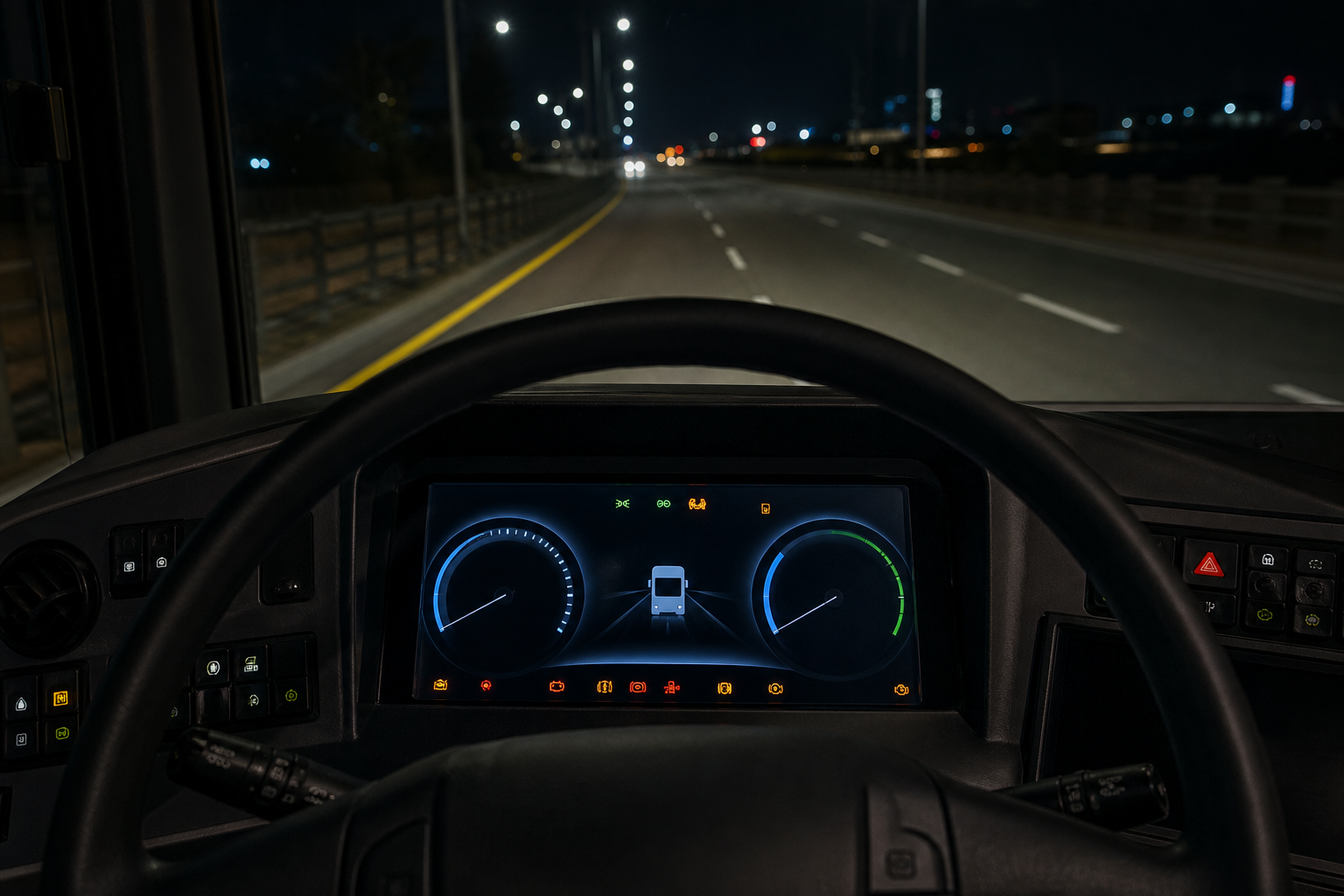
How to judge County Electric warning lights quickly
- Red: stop or inspect immediately. Brake, charging, EPS, airbag, and forward-attention alerts belong here.
- Amber: you may still be able to drive, but you should find the cause soon. TPMS, ABS, front-safety, EPB, ESC OFF, and EV battery warnings fit here.
- Green or blue: many are status indicators, but READY matters because it confirms the bus is truly drive-ready.
- EV bus specific: power down, high-voltage battery level, and battery conditioning affect output, charging plans, and thermal management.
16 County Electric warning lights worth checking before the next departure
These 16 signals were chosen for real County Electric driving decisions first. The official CSEV warning-light API can still list shared diesel icons, but this page focuses on the signals that matter most for electric bus operation and passenger safety.
| Type | Light | Meaning | What to do now |
|---|---|---|---|
| Immediate |  Brake Brake |
Parking brake applied, low brake fluid, or a braking fault | Slow down safely and inspect before the next route |
| Immediate |  Charging Charging |
12V support battery or charging-system issue | Reduce electrical load and arrange prompt service |
| Immediate |  Electronic power steering Electronic power steering |
Steering-assist system fault | If the wheel feels heavy, stop demanding driving and inspect it |
| Immediate |  Airbag Airbag |
Airbag or pretensioner fault | Do not ignore a crash-protection fault before carrying passengers |
| Immediate |  Forward attention Forward attention |
Driver-attention or monitoring warning | Read the message and judge whether a break is needed now |
| Combined |  Master warning Master warning |
Another system message or fault is waiting elsewhere on the cluster | Read the detailed message before guessing |
| Braking assist |  ABS ABS |
Anti-lock braking fault | Move the inspection up the list before wet or downhill routes |
| Tires |  Low tire pressure / TPMS Low tire pressure / TPMS |
Low pressure or TPMS issue | Check all four tires before carrying passengers again |
| Parking |  Electronic parking brake (EPB) Electronic parking brake (EPB) |
EPB operation or component fault | Check apply and release behavior on the next stop |
| Stability |  ESC OFF ESC OFF |
Stability-control function is switched off or unavailable | Check the switch first, then inspect it if it stays on |
| Safety assist |  Front safety Front safety |
Front-safety system blocked, disabled, or faulty | Check camera and radar contamination first |
| Night driving |  LED headlamp LED headlamp |
Headlamp system fault | Check lighting before early or night routes |
| EV core |  Power down Power down |
Vehicle output is being limited to protect high-power EV parts | Avoid hard acceleration and long climbs while checking battery status |
| EV core |  High-voltage battery level High-voltage battery level |
Drive battery charge is running low | Change the plan and head for a nearer charger |
| Status |  READY READY |
Confirms whether the bus is actually ready to move | Check READY before selecting drive and pulling out |
| Battery care |  Battery conditioning Battery conditioning |
Battery temperature-management mode is active | Use it as a clue when charging speed or output feels different |
Icons were checked against the official 2025 Hyundai County Electric CSEV warning-light API. Shared Hyundai-library diesel symbols can still appear, so compare your exact dashboard icon before assuming a match.
1. Red lights deserve faster attention when the bus feels quiet
Because the County Electric is so quiet, you cannot rely on engine sound to tell you how serious a problem feels. Brake, charging, EPS, airbag, and forward-attention warnings need a faster judgment because the bus may still feel calm while the cluster is already telling you to stop and check.
Charging is especially easy to misread on an EV bus. It can point to a 12V support-battery or charging-system problem, not just a charging-port message.
2. Master warning, TPMS, and front-safety alerts decide whether today's route is still comfortable to continue
Master warning means another message is waiting. Low tire pressure may feel minor in slow traffic, but it matters much more once you add passengers, frequent stops, and repeated braking heat.
Front safety, ABS, ESC OFF, and EPB can come from blocked sensors or settings, but if the function is really unavailable the difference shows up quickly in rain, tight stops, and downhill sections.
3. Treat power down, high-voltage battery level, and READY as the EV bus trio
Power down means output is being limited to protect high-power EV hardware. On a heavy shuttle, that can show up first during climbs, cabin cooling, or repeated pullaways from stops.
High-voltage battery level is your route-planning warning, while READY confirms whether the bus is truly prepared to move. Add battery conditioning when charging speed or power delivery feels different from normal.
4. Filter shared-library symbols through your actual powertrain
The CSEV warning-light list can still surface shared Hyundai symbols for fuel, GPF, urea, and diesel systems. That is a library behavior, not proof that every icon applies to an electric bus dashboard exactly as shown.
For County Electric drivers, the priority set is the EV-bus group: brake, charging, EPS, master warning, front safety, power down, high-voltage battery, and READY. If the icon still feels ambiguous, compare the cluster message and your exact model year before you decide.
5. Switch the model year before trusting a perfect match
This article is organized around the 2025 Hyundai County Electric CSEV. Even with the same model name, 2025, 2026, and 2027 model years can use different warning-light combinations and explanations. Open the official page, switch to your own year, and then compare the icon again.
How to switch the County Electric model year
- Open the official County Electric manual below.
- Use the model-year selector next to the vehicle name.
- Enter the warning lights & symbols section and match the icon again.
- If the cluster shows a text message too, trust the message before the icon title.
Related clean-commercial warning-light guides
In short, County Electric warning lights are easier to handle when you split them into stop-now red alerts, inspect-soon amber alerts, and EV-specific output or charging signals. When the symbol feels ambiguous, compare it directly against the official warning-light page instead of guessing.