Universe Fuel Cell Bus warning lights: 15 signals before the next highway route
Official 2025 Hyundai Universe Fuel Cell Bus warning-light guide covering 15 coach-critical signals, from brake and steering alerts to power down, high-vol...
The Universe Fuel Cell Bus spends long hours on highways with passengers on board, so one warning light can change safety, schedule, and recovery options very quickly. This guide is based on the official 2025 Hyundai Universe Fuel Cell Bus (PYFCEV) warning-light page and owner's manual and narrows the cluster down to 15 signals worth checking first.
Hyundai's shared warning-light library can still surface diesel or gasoline symbols on this route. So the safer workflow is to judge urgency first, then compare the exact icon and cluster message on the official page before assuming the label fits your coach exactly. Model year, trim, and hardware can still change the real dashboard.
Match the icon before you guess
Power down, high-voltage battery, READY, and master-warning cues can all look similar at a glance but lead to very different coach decisions. Open the official page first, then read the cluster message if one appears.
Check my dashboard icon on the official warning-light page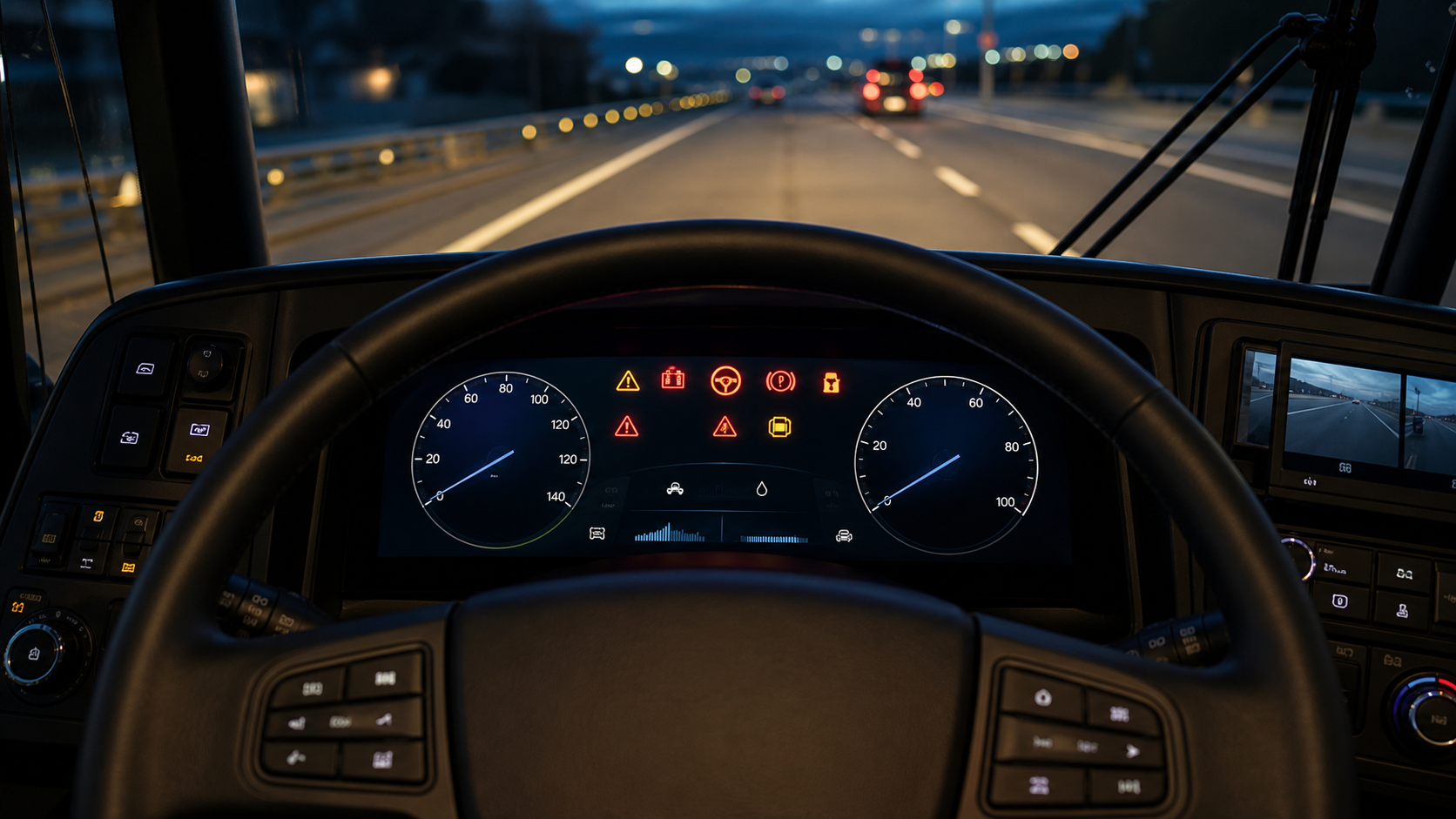
How to sort these warning lights quickly
- Red: stop or inspect immediately. Door-open, brake, charging, EPS, steering-safety, and driver-attention alerts belong here.
- Amber: you may still be able to move, but you should find the cause soon. TPMS, ABS, EPB, front-safety, lighting, power-down, battery, and master-warning alerts fit here.
- Green or blue: many are status indicators, but READY matters because it confirms whether the coach is truly drive-ready.
- Fuel-cell coach specific: hydrogen- or fuel-cell-side issues may show up through the cluster text together with power down, master warning, or high-voltage battery cues instead of one perfectly separate icon.
15 Universe Fuel Cell Bus warning lights worth checking before the next highway run
These 15 signals were chosen for real coach decisions first. The official PYFCEV warning-light list still behaves like a shared Hyundai library, so this page focuses on the signs that matter most for passenger safety, steering, braking, output restriction, and route continuation.
| Type | Light | Meaning | What to do now |
|---|---|---|---|
| Immediate |  Door open Door open | A passenger door or entry lock is not confirmed properly | Do not depart until the door status is secure |
| Immediate |  Brake Brake | Parking brake, low brake fluid, or a braking fault | Slow down safely and inspect before continuing |
| Immediate |  Charging Charging | 12V support battery or charging-system issue | Reduce electrical load and arrange prompt service |
| Immediate |  Electronic power steering Electronic power steering | Steering-assist system fault | If the wheel feels heavy, stop demanding highway driving and inspect it |
| Immediate |  Steering safety Steering safety | A steering-related safety function may have a fault | Rejudge the run before the next ramp or fast curve |
| Immediate |  Driver attention Driver attention | Driver-monitoring or forward-attention warning | If a fatigue message appears too, stop and take a break now |
| Combined |  Master warning Master warning | Another subsystem message or fault is waiting elsewhere on the cluster | Read the detailed message before guessing from one icon |
| Braking assist |  ABS ABS | Anti-lock braking fault | Move the inspection up the list before rain or a long descent |
| Tires |  Low tire pressure / TPMS Low tire pressure / TPMS | Low pressure or TPMS issue | Check all tires before the next high-speed leg |
| Parking |  Electronic parking brake (EPB) Electronic parking brake (EPB) | EPB operation or component fault | Confirm hold and release behavior before the next terminal stop |
| Safety assist |  Front safety Front safety | Front-safety system blocked, disabled, or faulty | Check camera and radar contamination first |
| Night driving |  LED headlamp LED headlamp | Headlamp system fault | Check lighting before a dawn or night departure |
| Fuel-cell core |  Power down Power down | Output may be limited to protect the fuel-cell or electric drive system | Avoid hard acceleration and long climbs while checking the cluster message |
| Fuel-cell core |  High-voltage battery level High-voltage battery level | Drive-battery state may be too low for the next segment | Change the plan and head for a nearer support or charging point |
| Status |  READY READY | Confirms whether the coach is actually ready to move | Check READY after the doors close and before you pull away |
Icons were checked against the official 2025 Hyundai Universe Fuel Cell Bus PYFCEV warning-light API. Shared Hyundai-library diesel and gasoline symbols can still appear, so compare your exact dashboard icon and message before assuming a match.
1. Red lights deserve the quickest attention on a highway coach
On the Universe Fuel Cell Bus, door-open, brake, charging, EPS, steering-safety, and driver-attention warnings need a faster judgment than they would in an ordinary passenger car. On a long-distance coach, one more kilometer can still be a bad idea.
Charging is especially easy to misread here. It can point to a 12V support-battery or charging-system problem, not just a simple fueling-port misunderstanding.
2. Master warning, TPMS, and front-safety alerts decide whether the coach still feels safe to continue
Master warning means another message is waiting. Low tire pressure may look minor at a stop, but it matters far more once you add highway speed, passenger load, and long-distance heat.
Front safety, ABS, EPB, and LED headlamp issues can come from blocked sensors or settings, but if the function is really unavailable the difference shows up quickly in rain, darkness, and high-speed lane changes. For a direct diesel comparison, see the Universe diesel warning-light guide.
3. Treat power down, high-voltage battery, and READY as the fuel-cell coach trio
Power down means output may be limited to protect the fuel-cell or electric-drive side. On a large coach, that matters most on climbs, overtakes, and heavy HVAC load.
High-voltage battery state is your route-planning warning, while READY confirms whether the coach is truly prepared to move. If a hydrogen- or fuel-cell-related message appears with them, treat the text message as part of the decision, not background noise. For another hydrogen-heavy commercial reference, compare it with the XCIENT Fuel Cell Truck warning-light guide.
4. Treat hydrogen or fuel-cell service messages as technician territory
The PYFCEV warning-light route still behaves like a shared library, so hydrogen-side issues may not always present as one perfectly isolated icon. Instead, they can appear through cluster text together with master-warning, power-down, or battery-related cues.
If the cluster points toward the hydrogen or fuel-cell side, the safer move is to follow the official manual and service path instead of improvising with a roadside inspection. If you want a city-bus comparison, also see the Elec City Fuel Cell Bus warning-light guide.
5. Switch the model year before trusting a perfect match
This article is organized around the 2025 Hyundai Universe Fuel Cell Bus PYFCEV. Even with the same model name, 2025, 2026, and 2027 model years can use different warning-light combinations and explanations. Open the official page, switch to your own year, and then compare the icon again.
How to switch the model year
- Open the official owner's manual below.
- Use the model-year selector next to the vehicle name.
- Enter the warning lights & symbols section and match the icon again.
- If the cluster shows a text message too, trust the message before the icon title.
In short, Universe Fuel Cell Bus warning lights are easier to handle when you split them into stop-now red alerts, inspect-soon amber alerts, and fuel-cell-specific output or route-planning signals. When the symbol feels ambiguous, compare it directly against the official page instead of guessing.