Mercedes E-Class W214 warning lights: 16 signals to check first
Official 2026 Mercedes-Benz E-Class W214 guide to 16 key warning lights, including brakes, coolant, engine diagnostics, tire pressure, electrical faults, A...
A warning light in a Mercedes-Benz E-Class W214 is only half the message. The colour, the exact icon, and the text in the driver display decide whether you can continue or need to stop. This guide uses the official June 2026 E-Class Saloon W214 owner's manual and warning-light index to focus on 16 signals that matter most. Equipment, powertrain, and model-year differences can change what appears in your car.
Match your dashboard icon with the official source
Red and amber versions of a similar symbol can require very different actions. Check the driver-display message as well.
Open the official W214 warning-light index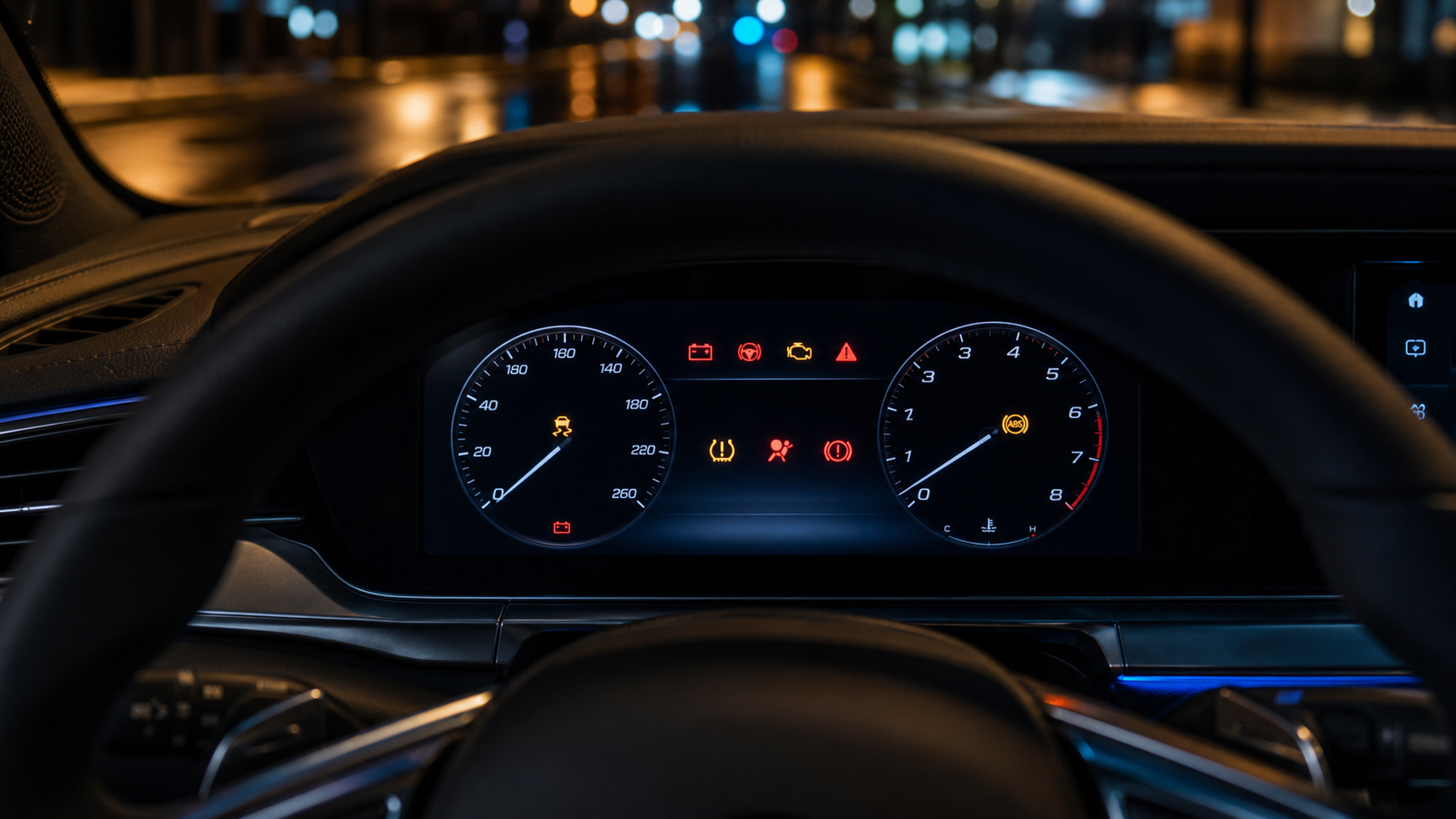
Use colour as the first filter
- Red: brake, coolant, electrical, steering, or collision warnings can require an immediate stop.
- Amber: engine, ABS, ESP, tire, and assistance faults need prompt diagnosis even if the car still drives.
- Green or blue: usually a status indication, but any unusual display message still deserves a manual check.
- Equipment-specific: reduced output, suspension, and electrified-system warnings depend on the fitted powertrain and options.
16 E-Class W214 warning lights to check first
| Priority | Light | Meaning | What to do now |
|---|---|---|---|
| Stop now |  Red brake Red brake | Low brake fluid or reduced brake assistance may impair braking | Stop safely, do not continue, and contact qualified service |
| Parking brake |  Electric parking brake Electric parking brake | Brake applied or parking-brake malfunction | Check engagement and read the display message |
| Stop now |  Red coolant Red coolant | Low coolant, sensor, fan, pump, or overheating fault | Switch the vehicle off and let it cool before inspection |
| Occupant safety |  Restraint system Restraint system | Airbag or belt pretensioner fault | Arrange immediate qualified inspection |
| Steering |  Power steering Power steering | Steering assistance or fitted rear-axle steering fault | Do not push on if steering effort or response changes |
| Electrical |  Electrical system fault Electrical system fault | Electrical or fitted electrified-drive system problem | For a red warning, follow the stop instruction on the display |
| Engine |  Engine diagnostics Engine diagnostics | Engine management, emissions, fuel, or emergency-mode fault | Reduce driving and inspect promptly, sooner with vibration or power loss |
| Brake support |  ABS ABS | ABS or EBD fault may increase lock-up and stopping risk | Stop if paired with red brake warning; otherwise inspect promptly |
| Stability |  ESP ESP | Flashing means intervention; steady illumination may mean a fault | Slow for conditions and inspect a persistent light |
| Tires |  Tire pressure Tire pressure | Pressure loss or monitoring-system malfunction | Stop safely and check all tires for pressure and damage |
| Front safety |  Active Brake Assist Active Brake Assist | Automatic braking assistance is limited or unavailable | Check sensor areas and rely on your own braking margin |
| Collision risk |  Distance warning Distance warning | Following distance is critically short | Prepare to brake immediately and increase the gap |
| Power limited |  Reduced output Reduced output | Drivetrain protection or power restriction | Avoid overtaking and hard acceleration; read the exact message |
| Ride control |  Suspension Suspension | AIRMATIC or fitted ride-control fault | Slow down if red or if the vehicle's behaviour changes |
| Driver support |  Attention Assist Attention Assist | Driver-attention alert or system fault | Take a break for fatigue; service a persistent system fault |
| Emergency call |  eCall eCall | Emergency-call or support-system malfunction | Have it checked because emergency communication may be affected |
The symbols were checked against the official June 2026 E-Class W214 warning pages. The driver-display wording and colour remain decisive.
Red brake, coolant, steering, and electrical warnings come first
A red brake warning can indicate low fluid or reduced brake assistance, not merely a parking brake left on. The official manual warns that pedal effort and stopping distance can increase. Stop safely and do not keep driving. A red coolant warning also calls for a stop and shutdown; do not rush to open a hot engine bay.
For oil pressure and battery faults, read the display text
The W214 warning index groups many faults under engine diagnostics, electrical systems, and detailed driver-display messages. If you see an oil-pressure, oil-level, 12V/48V battery, or charging message, do not rely on a familiar oil-can or battery shape from an older car. A red oil-pressure or charging-system message is not an invitation to continue driving.
ABS, ESP, tires, and front-assistance warnings interact
A flashing ESP lamp can be normal intervention; a steady lamp can mean the stability function is unavailable. ABS combined with the red brake warning raises the priority sharply. A tire-pressure lamp that flashes for about a minute before staying on can point to a monitoring fault rather than pressure loss alone.
The W214 often uses feature-specific icons and display messages instead of one generic master-warning triangle. For Active Brake Assist or sensor restrictions, read the exact message and increase your own braking margin.
Powertrain and option warnings vary by vehicle
W214 powertrains and equipment differ by market and trim. Reduced output, electrical-system, AIRMATIC, and rear-axle-steering warnings only apply where those systems are fitted. Avoid hard acceleration or overtaking when power is limited, and match the message to your exact manual edition.
Select the correct model year and generation
This guide targets the June 2026 E-Class Saloon W214. A 2025, 2026, or 2027 edition can change warning availability and wording. W213 and W212 cars also use different display systems, so select the correct edition on the official site before relying on a match.
Official references
Related warning-light guides
In short: stop first for red safety warnings, diagnose amber faults promptly, and always pair the icon with the exact driver-display message and manual edition.