Hyundai IONIQ Electric warning lights: 16 dashboard signals to check first
Official 2020 Hyundai IONIQ Electric guide covering 16 dashboard signals, from brake, charging, EPS, and airbag alerts to ABS, TPMS, front-safety, power-do...
The Hyundai IONIQ Electric can stay quiet even when the dashboard is asking for a fast decision. Brake, charging, EPS, airbag, TPMS, power-down, and high-voltage battery alerts change how safely you should keep driving. This guide uses the official 2020 Hyundai IONIQ Electric (AEEV) warning-light page and narrows the cluster down to 16 signals worth checking first.
Compare the exact symbol before you guess
Hyundai's shared warning-light library can still show fuel, engine, GPF, AWD, or hybrid icons beside the IONIQ Electric set. Use the priority table first, then compare the exact symbol against the official page.
Open the official IONIQ Electric warning-light list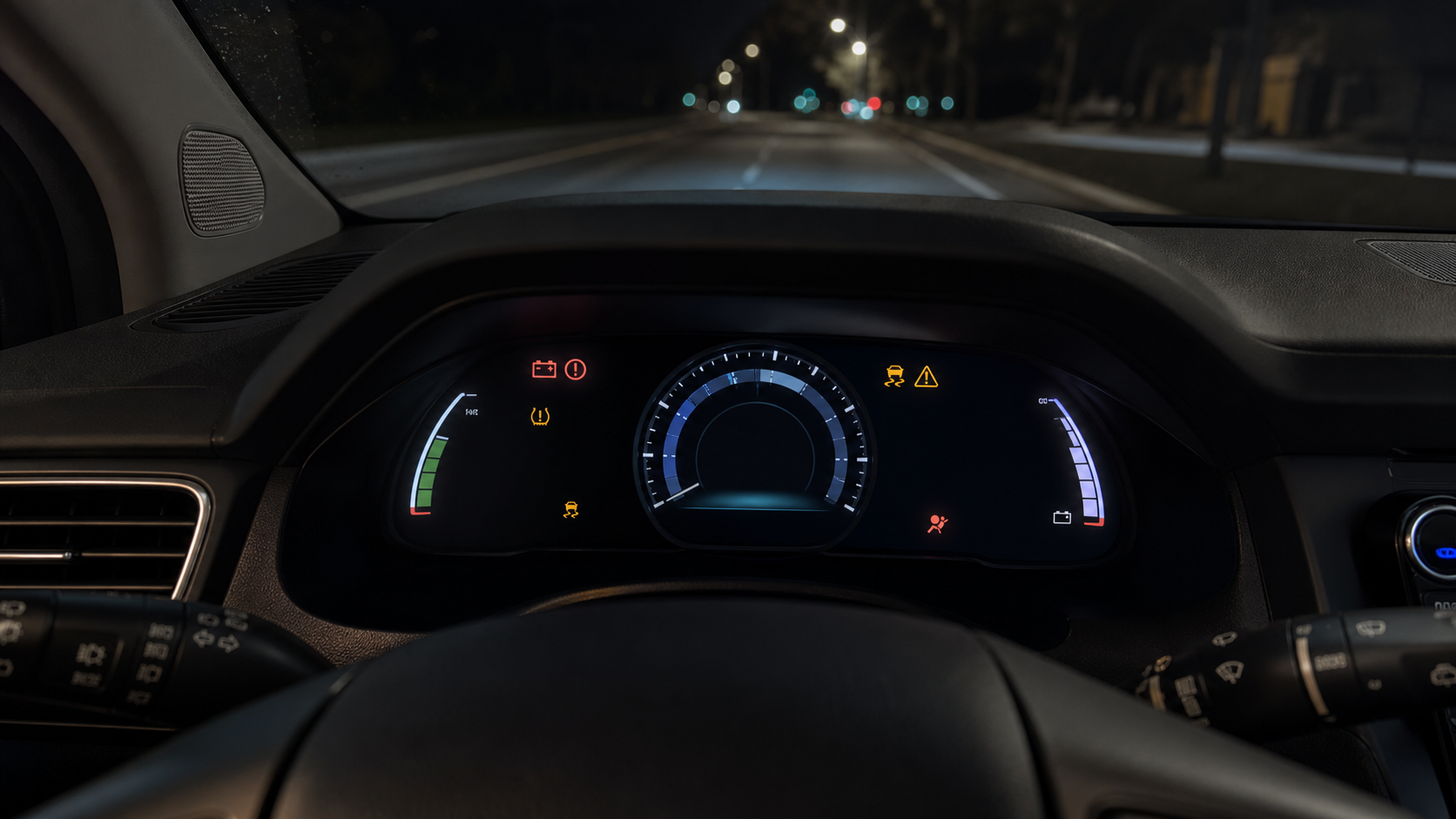
Read the lights in this order
- Red: brake, charging, EPS, airbag, and forward-attention alerts deserve immediate attention.
- Amber: ABS, TPMS, EPB, ESC, front-safety, master warning, LED headlamp, power-down, and high-voltage battery alerts need quick diagnosis.
- Green: READY is usually a status light, but it still matters if it disappears or flashes unexpectedly.
- EV focus: power-down, high-voltage battery, and battery conditioning affect range, output, and charging plans.
16 IONIQ Electric dashboard signals worth checking first
| Priority | Warning light | Meaning | What to do now |
|---|---|---|---|
| Stop and verify |  Brake Brake | Parking brake, low brake fluid, or braking-system fault | Slow down safely and inspect if it stays on while driving |
| Stop and verify |  Charging Charging | 12V support battery or charging-system issue | Reduce electrical load and inspect quickly |
| Stop and verify |  EPS EPS | Electric power steering fault | If the wheel feels heavy, stop forcing the drive |
| Stop and verify |  Airbag Airbag | Airbag or pretensioner problem | Do not ignore a crash-protection fault |
| Stop and verify |  Forward attention Forward attention | Immediate driver-attention or monitoring alert | Check the cluster message and surroundings at once |
| Brake support |  ABS ABS | Anti-lock braking fault | Be more careful in rain or hard braking until it is checked |
| Tires |  Low tire pressure / TPMS Low tire pressure / TPMS | Low pressure or TPMS issue | Check all four tires before the next faster drive |
| Parking |  EPB EPB | Electronic parking-brake problem | Confirm engage and release behavior, then inspect |
| Stability |  ESC ESC | Stability-control intervention or fault | Blinking can be normal, solid still needs attention |
| Drive status |  READY READY | Vehicle is prepared to drive | If it disappears or flashes unexpectedly, check the car state |
| Front safety |  Front safety Front safety | Forward-safety sensor blockage or system fault | Clean the camera and radar area first |
| Combined alert |  Master warning Master warning | Another subsystem message is waiting in the cluster | Read the cluster detail message before guessing |
| Night driving |  LED headlamp LED headlamp | Headlamp-system problem | Verify lighting before the next night drive |
| Steering safety |  Steering safety Steering safety | Steering-assist safety function problem or sensor issue | If cleaning sensors does not help, inspect it |
| EV core |  Power down Power down | Output is being limited to protect high-power components | Avoid hard acceleration and watch battery condition |
| EV core |  High-voltage battery High-voltage battery | Drive battery charge is critically low | Choose the nearest charger before the destination |
These icons were checked against the official 2020 Hyundai IONIQ Electric warning-light API. The shared Hyundai library can still expose fuel, engine, GPF, AWD, or hybrid entries, so always compare the exact symbol and cluster message.
1. Red alerts still come before the next errand
Brake, charging, EPS, airbag, and forward-attention alerts should not be pushed into a later stop. The IONIQ Electric is quiet enough that a serious problem can feel less dramatic than it is.
2. Power-down and battery alerts change your route, not just the dashboard
The power-down icon is not a mild comfort notice. It can mean the car is protecting the drive system by limiting output. The high-voltage battery alert means charging becomes the next decision, not the one after that.
READY and battery conditioning look less dramatic, but they still matter. READY confirms the car is actually prepared to move, and battery conditioning explains why charging or thermal management may be active.
3. Always switch to your exact model year before the final match
This article is based on the 2020 Hyundai IONIQ Electric AEEV. Even under the same name, warning-light explanations can shift across the 2016, 2017, 2018, 2019, and 2020 model years. Change the year on the official page before you trust the match.
In short, IONIQ Electric warning lights are easiest to manage when you separate stop-now red alerts, inspect-soon amber alerts, and EV-specific range or output signals. When the symbol still feels ambiguous, compare it directly against the official page instead of guessing.